
A Translation Project by Emma De Lisle, Talin Tahajian, and Sam Bailey
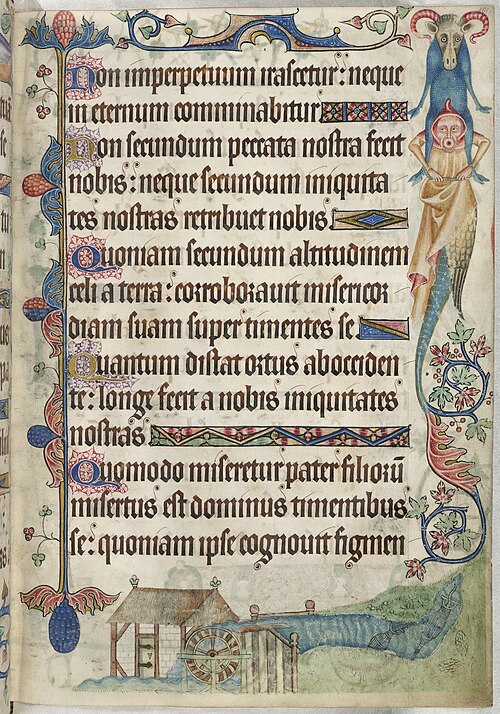
Psalms 38, 102, and 130 are three of the so-called “Penitential Psalms” of the Hebrew Bible, a set of seven psalms said to have been written by King David in c. 1000 B.C.E, selected from a large number used in the Matins of the Office of the Dead in the Catholic and certain Protestant traditions. Their origin as a category is obscure: they are first mentioned in the sixth century by Roman monk Cassiodorus, who makes it clear that they were already circulating together at that time. Throughout the Middle Ages and into the Renaissance, these seven psalms continued to be translated and retranslated as a group. Our translations are from the Latin Vulgate, a Bible whose translation into medieval Latin from Hebrew and Koine Greek was overseen by Saint Jerome at the end of the fourth century C.E.
The history of psalm translation in English has often been dependent on verse paraphrase, a particular interpretive mode that involves the expansion of each psalm verse across the open field of the stanza, as opposed to other forms of translation that prioritize word-by-word precision. From Richard Rolle’s English Psalter (c. 1348) to Thomas Wyatt’s translations of the seven penitential psalms (1536) and Anne Locke’s “Meditation of a Penitent Sinner” (1560), the first sonnet sequence in English, these works engaged the psalms not by replicating them word for word, but by interpenetrating them with the poet’s own voice.
When we began to translate the Penitential Psalms ourselves, we had not discussed the particulars of verse paraphrase versus other kinds of translation. As we worked our way through them, however, we each found ourselves expanding upon their verses more and more, ultimately arriving at this form, which has served as one of the default means for English translators of the psalms for centuries. We think this happened because the process of writing oneself into the predicament of the psalmist works only if the translator prioritizes affective utility over textual accuracy. In other words, she must ask the question: What are the psalms for? In the Christian tradition, they are an instruction in prayer, and in speaking out to God from a position of sinfulness. It is only then that sin can be transformed into something redemptive: by speaking as the psalmist—with all his nerve to call God down—the translator speaks in the language of scripture, and by speaking scriptural Word, she encounters Christ, transforming herself and her sin in his image.
Read the Translations
Sam Bailey’s poems appear in Yale Review, Best New Poets 2025, Missouri Review, Image, Adroit Journal, Colorado Review, and elsewhere. He’s a Ph.D. student in religion at Harvard University and serves as an editor for Peripheries. Emma De Lisle’s most recent work appears in 32 Poems, Changes Review, Indiana Review, Massachusetts Review, New Ohio Review, Missouri Review, and Washington Square Review. She lives in Western Massachusetts. Talin Tahajian is from Massachusetts. She is a Ph.D. candidate in English at Yale, and an assistant editor of Yale Review. Her poems appear widely in journals and magazines. Bailey, De Lisle, and Tahajian are editors of Mark: A Journal of Christian Poetics.