
By Oak Morse
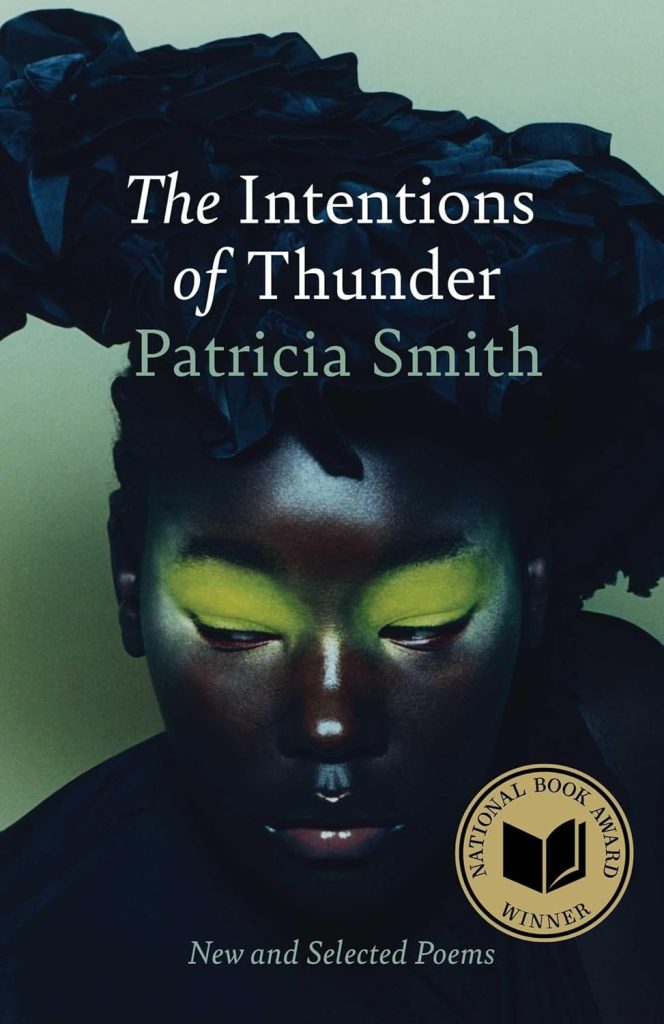
The Intentions of Thunder, by Patricia Smith. Scribner, 352 pp., $30 (hard).
One theme in Patricia Smith’s The Intentions of Thunder: New and Selected Poems, is the poet’s refusal to let motherhood remain private. She nationalizes it. A mother’s natural instinct to protect quickly turns into a powerful statement about society’s failings. The collection frames the Black mother not as sanctuary but as frontline, absorbing the republic’s violence and refusing its amnesia. Brutality is neither metaphor nor backdrop. Racism arrives like a daily forecast: unavoidable and atmospheric, especially in the poems centered on Black boys. Speaking both within and beyond the lyric, a mother’s restraint amplifies urgency rather than softening it. Death rests on the tongue and hovers in anticipation:
The poem closes: “So I climb the stairs to my son’s room / … / He deserves one more moment of not knowing that boy’s face.” Knowledge becomes a burden passed down the staircase.
The engine of the poem runs on postponement, on the labor of “keeping from saying dead.” Grief is not ornamental; it is structural. Smith anchors anguish to history rather than abstraction. In poems composed over many years, references to Tulsa, Rodney King, Ferguson, and Hurricane Katrina insist that this violence is cumulative, not episodic. In Katrina’s wake, “hotels are kicking people out,” while in St. Bernard Parish, twenty-four bodies are found drowned in nursing homes. The archive expands backward:
The repetition of “bleached white” performs its own indictment. The poem documents what the state prefers to misfile. Does the sheer accumulation of brutality risk a kind of oversaturation? You wonder if the reader will go numb, if horror will begin to feel routine. But Smith seems to anticipate this danger. She counters it not by retreating but by shifting register, moving from combustion to containment. Earlier poems pulse with bravado and persona; later diction earns authority through restraint.
A lush Black vernacular threads the work from plantation-era language to old-school slang: “girl yousa fool,” “fatback,” “Jheri Curl homegirl,” “frying skillet.” This language does not merely decorate; it incarnates. Black girls and women do not simply speak; they move inside their speech, dancing, conjuring, surviving, declaring themselves unfinished architects of becoming. In poems lit by the Motown era and heavy with inheritance—one poem insists, “Girlfriend, you and I are too scream for this place”—language becomes both offering and weapon. In “The Architect,” the speaker insists the building is not finished, that construction persists despite ruin.
Smith trusts structure over flourish. Traditional stanzas sit evenly stacked, urgency contained inside their borders. When fracture is required, language splinters: “clouded bottle of pepperminty funk,” “we are a mother humming shards of gospel,” “bolt my ghost to the kitchen floor so you can find me in the morning.” Musicality steadies the line:
Forms such as sestinas and golden shovels extend this discipline, honoring constraint while resisting sentimentality. The poems move beyond free verse toward formal rigor without sacrificing heat.As someone who has watched classrooms fall silent over a single line of poetry, I recognize that turn when language leaves the page and enters the room. Smith seems to write toward that moment. In the ars poetica “Close to Death,” she writes:
The implication is clear: poetry must answer to the everyday. It must travel beyond the page.
Two later sections of the book, “Incendiary Art” and “Uncollected 2010–2024,” gather decades of witness. Exhaustion shadows the tone, mirroring lived repetition. The poems do not rely on shock but on familiarity. Danger persists: “Today, one said I sure would / like to burn a black man alive.” In “Sagas of the Accidental Saints,” the refrain echoes across eight pages: “the gun said: I just had an accident.” Repetition becomes accusation.
It is telling that Black poets have won the National Book Award for Poetry in six of the last ten years. This is not merely a streak of luck; it is a signal that the literary world is finally prioritizing the kind of counter archive work Smith has been doing for years, writing that refuses to let the official record go unchallenged. Instead of merely looking back, The Intentions of Thunder constructs a counter narrative. Domestic detail, music history, maternal address, vernacular cadence, and killings accumulate into documentation. Smith’s voice holds mother, son, drowned bodies, and unnamed girls. The work charts an evolution not toward softness but toward stewardship. The poems do not merely rumble; they insist. What has been silenced must be heard.
Oak Morse lives in Fort Lauderdale, Florida, and holds an MFA from Warren Wilson and an MLIS from the University of Southern Mississippi. He won the 2025 Larry Levis Post-Graduate Award and the 2024 A Public Space Writing Fellowship.