
Shara Lessley on Contemporary Poets
A Great Disturbance: Charting the Way Forward
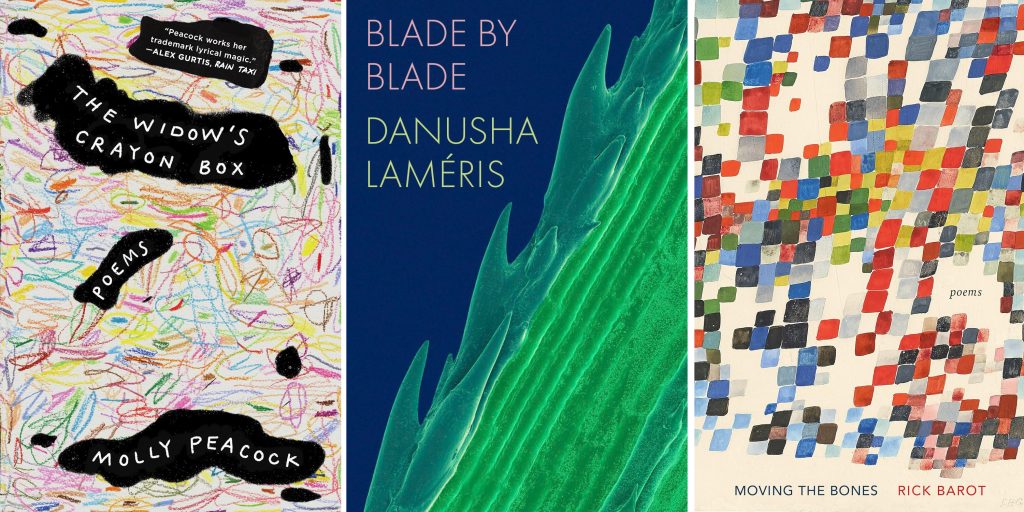
Moving the Bones, by Rick Barot. Milkweed Editions, 88 pp., $16.
Blade by Blade, by Danusha Laméris. Copper Canyon Press, 96 pp., $17.
The Widow’s Crayon Box, by Molly Peacock. W.W. Norton, 112 pp., $16.95.
Much is made of beginnings and endings, the first line of a poem or its closing stanza. We see critical attention given to prize-winning debuts, collected bodies of work, and books published posthumously. But what about middles? The volta of the writing life, so to speak. In We Begin in Gladness, which considers the development of lyric greats like W.S. Merwin, Terrance Hayes, francine j. harris, and Louise Glück, among others, author Craig Morgan Teicher describes poetry as “a conversation, an extended one, occupying, perhaps the span of an entire life …” As Teicher follows the expansion and complication of a poet’s work over time, what becomes clear are the outside pressures requisite for growth; that is, experiences that disrupt one’s writerly habits and ways of pattern-making. It’s these moments of transition or between-ness that often lead to the discoveries that enlarge the shape and reach of a poet’s work.
Recent collections by Molly Peacock, Danusha Laméris, and Rick Barot find their authors grappling with circumstances beyond their control, facing an emotional landscape of uncertainty and unrest. Peacock mourns the loss of a spouse. Laméris measures the joy of the natural world against the startling realities of the Anthropocene. During the period of an ongoing global health catastrophe and historic isolation, Barot takes stock of life and longing from the perspective of mid-adulthood. For all their differences in subject, form, and structure, however, The Widow’s Crayon Box, Blade by Blade, and Moving the Bones share some notion of upheaval: a triggering event that alters and reorients the poets as they move through what critic M.H. Abrams calls “a varied but integral process of memory, thought, anticipation, and feeling.” This translation from experience to inwardness to lyric expression manifests clearly throughout the given collections. “It seemed external to us both—an awe / of what we were about to do (a sane / alternative to modern agony),” writes Peacock in “Deciding to End Your Life, You Thank Me (MAID: Medical Assistance in Dying, Toronto).” And Barot: “At each opened grave, we think about the body taking its shape as father / sister, cousin, uncle. We hunger for the story of each figure” (“Moving the Bones”). Yet even in moments of distress and while carrying the weight of sorrow, each collection brims with models of resilience, reconciliation, consolation, and renewal; poems that affirm the vital connection among the living. As Laméris concludes in “What Begins,”
I
Far from Sylvia Plath’s depiction of the widow as “that great, vacant estate!”, Molly Peacock’s latest collection, written from the perspective of surviving spouse, undermines the trope of the grieving woman as a “bitter spider” sitting solitary “in the center of her loveless spokes” (S.P., “Widow”). Divided into four sections—“After,” “Before,” “When,” “Afterglow”—The Widow’s Crayon Box traces the shock, solitude, yearning, anger, disorientation, love, and exhaustion accompanying the fact that Peacock’s “lifelong friend is gone” (“The Realization”). While the poet acknowledges her own preconceptions that “A mourning widow is still, gray and mauve. / A mourning widow, umber, barely moves,” the death of her husband recasts the world not in prescriptive shades of black and gray, but the more vibrant hues of burnt sienna, rose, peach, “Scarlet, orchid, cerise” as Peacock renders a palette of grief that runs the gamut (title poem).
As formally varied as it is filled with shades of pathos, The Widow’s Crayon Box proves “The eight child-colors … / are far too basic and behaved” to adequately evoke the loss of her beloved (title poem). The collection opens with “Touched,” whose repetitions, inversions, qualifications, and end rhymes beautifully enact the dizzying effects of life turned upside down by loss. “When I feel moved and then say I am touched,” opens the speaker, “it’s another presence inside me I sense.” With this initial gesture, Peacock emphasizes the interplay between physical and emotional states as, over the course of the poem, “touched” and “moved” serve as both action and feeling, verb and adjective. Five lines in, and after introducing a canoeing metaphor featuring the engagement of water and paddle, the poem suddenly turns via the direct address:
Here, Peacock shifts the opening’s scheme ababb to ccdcd, a pattern she’ll alter again in the next five lines before abandoning rhyme altogether in the poem’s final moments. The above excerpt not only features the binding sounds of me / gradually / me and gone / done, however. Note, too, the epistrophe “next to me” and how Peacock qualifies and then revises the prepositional phrase from “I felt you next to me” to “you’re not next to me.” Isolated this way, the language emphasizes a shift from physical presence to absence. However, read within the full context of their respective sentences, Peacock’s lines suggest nearly the opposite. Although the widow initially senses her husband’s presence, he “gradually” disappears into death’s lake. Ironically, it’s his physical absence that ushers in a new iteration of intimacy: now “internalized,” the beloved is remade, rediscovered, felt, and more deeply known in absentia.
As “Touched” progresses, Peacock beautifully depicts the paradoxes of grief: namely, all looks the same and yet is not; and, too, while the person who died is physically invisible, his survivors remain invisibly altered. “My loneliness is so extreme,” confesses the speaker, “that I feel moved by almost anything, / even the forehead of a dog that leans / against my knee in an elevator, things / as brief as all the ways you would lean / against me getting a glass of water / at the sink …” Peacock’s images are telling: the dog’s innate friendliness and temporary companionship; elevator’s ups and downs as it loops occupants toward their inevitable departures; a couple’s sink-side interaction as emblem of domestic intimacy. “Water,” of course, echoes the poem’s early metaphor of a “canoe being launched” across a lake into which the spouse disappears, but also initiates Peacock’s final declaration—a syntactic rearrangement of the poem’s opening—“Everything touches me, / now that I’m not touched, but moved.” Dangling at the end of the penultimate line, the word “me” calls out to its early predecessors: the poem’s identical rhyme me-me-me further emphasizing the speaker’s seclusion and melancholy. Yet, while pain is evident, “Touched” illustrates loss’s ability to open new forms of sensitivity and sensibility. It’s no coincidence that Peacock’s other identical rhyme is “sense”; a word that variously suggests conscious awareness, bodily perception, discernment, and meaning-making—all things that are challenged and changed by grief.
In many ways, “Touched” serves as a reader’s guide to The Widow’s Crayon Box. As Peacock teases out the intricacies of loss, the collection’s terrible irony becomes clear: that the lyric comes most alive when met by the anticipation of death and its aftermath, mourning. There are moving accounts of Toronto’s Medical Assistance in Dying program (“Deciding to End Your Life, You Thank Me”) and the view from inside the “Creation Room: Invited to Press the Button.” Yet, while Peacock’s poems often meet expectations of the elegy as part tribute and part lament, they’re also energized—and, sometimes even revitalized—by a peculiar “newness” of feeling, however devastating it may be. Wonders the speaker of the couple’s archived epistles, “Dust puffs up. Moats materialize the old love. // Which one is realer? Then, when so much younger?” “No,” she concludes “it’s now, warm for a moment, in the arms of a folder” (“Love Letter in the Storage Locker”). Moving from agonizing truth to solace, it’s day by day that Peacock begins to understand “the fabric of absence, / the soft, thready scent of lost affection, / is what gives loneliness its worth” (“Moved & Touched”). As she observes in “The You-Spot”: “But now that you live in my mind we’re more even / than even we were; your ghost hand’s the sympathy / I yearned for but couldn’t humanly have before.”
Long admired for her dynamic structural innovation and musical intelligence, Peacock devotes a significant portion of the collection to sonnets, including two sequences that cover illness, dying, caregiving, and devotion. The structural ghosts of other forms, traditional and invented, likewise haunt the book. “Organic Sadness, Compost Style,” for example, subverts the heart’s “lubdub” to demonstrate there’s “heat inside” organic matter as it breaks down, as well as in the undoing of language itself. A wave of repetition drives seven couplets forward via anaphora, epistrophe, perfect rhyme, and patterned phrasing, “All melting, merging,” Peacock writes, until shredding becomes shedding, loosing becomes losing, and “every other thing” yields “every into thing.” Wrenched from its original context and remade by the very fact of it’s being unmade, Peacock’s diction generates fresh energy until meaning gives way and all that’s left is “All umber inside the umbra of feeling.”
If sorrow in William Carlos Williams’s “The Widow’s Lament in Springtime” dissolves the branches’ yellows and reds and leaves the bereaved wishing she could sink in a marsh, the season of grief in The Widow’s Crayon Box inverts this trajectory. “The Afterglow,” as its title suggests, finds Peacock living in “Purple and peach streaks / Behind the near-night clouds // … getting used to twilight.” The collection concludes with “Honey Crisp,” a free verse poem in which Peacock addresses an uneaten piece of fruit left six months in the refrigerator following her husband’s death. Teetering between humor and flat detachment, “Hello my honey crisp (well, / my honey, no longer crisp…),” the widow-speaker teases before adding, “You were earmarked for the date / he slipped from my arms & we both / slid to the floor, red angel, are you / listening?” Knowing an apple a day can’t keep sorrow away, Peacock moves forward as weeks and months bring new greetings and groceries, a different version of life. Still, the grieving wife isn’t ready to say goodbye. “[W]ould you rather / have been eaten and / lived on as energy?” she asks, though quickly answers, “Not yet, not yet my pomme.” Forestalling separation, Peacock’s invocation of the French term of endearment clarifies what the poem has previously hinted: namely, the apple serves as companion and material representation of the deceased. “Hello,” the poem ends, “soft wrinkled / face in my palms.” The “face” the speaker envisions is undeniably the speaker’s husband’s, although it’s the word “Hello”—repeated five times in “Honey Crisp”—that’s most significant. Rather than punctuating the collection with goodbye, Peacock brilliantly gestures toward another beginning. Hello, new self, she seems to imply. Hello, after-life. Hello, until death us do part.
II
While much of elegiac tradition assumes isolation or despair, Danusha Laméris counters this existential loneliness by pressing against the illusion of separateness. In Blade by Blade, the poet’s third collection, meticulous attention to nature underscores the interconnectedness of living things on a planet that is both dying and wildly alive. “The sun is older than we want to think, already,” observes Laméris, “past midlife, its years of fusion finite” (“Everything Old”). Using a form that dates back at least to 100 AD, Laméris’s “list” poem, a.k.a. catalog verse, serves as a storehouse in which various fauna and flora, feelings, weather, inventions, pictographs, fossils, and material possessions aren’t deemed more or less valuable than their counterparts, but, rather, part of the historical continuum. Whether ocean or moon, “ancient lament” or the “sound of awe,” “years of lean, years of plenty,” “the rain, the snow, the fox, hiding in its den”: “… these, too, are old,” contends the speaker, the sorrow and joy of experiencing such things “unlikely / to alter.” In its inclusiveness, “Everything Is Old” consoles. The poem’s anxiety? That the universe is both ageing and aged, its population disappearing inevitably with it. Yet, although language itself—our principal means of recordkeeping, communication, and expression—“is old, dying even as we write it down,” Laméris finds solace in pondering our transitory nature; that is, in the contemplation of “silence, its weighted grace” that accompanies death, “the oldest thing of all.”
While Laméris marvels at the pleasures of “washed-up bits of abalone, oyster, clam, / sidestepping the glutinous bodies of jellyfish” (“Barefoot”), “the telltale bumps on the back of a cane toad” (“Slither”), and the “blonde manes and thick flanks, / accompanied by the warm, / earthen odor of manure” (“Clydesdales”), Blade by Blade’s more somber entries revisit the death of a child and brother, respectively. In poems like “Appointment,” “Boy,” “Hair of the Dead,” and “Haunts,” Laméris circles the subject of loss, showing considerable power in narrative reticence. In fact, it’s by withholding detail that Laméris builds suspense and pathos. “Blue Note,” for example, recounts the “red-carpet days” of twenty-something siblings in Oakland, their lighthearted hours passed at communal gatherings and potlucks, “chef-ing up roasted beets / and everyone hanging out.” While it starts innocuously enough (“My brother named all his houseplants after jazz musicians”), the poem soon unsettles this carefree scene via the introduction of an underlying health crisis that Laméris ambiguously calls “the story we were born to”. “I thought we’d gotten out / beyond the worst of it,” reassures the speaker two-thirds through “Blue Note,” as “… the years kept ticking, / and the friends kept coming, and his children arrived, / curled and new in their cribs.” If the entrance of a new generation feels like a positive omen for the siblings, the poem’s plot quickly counterturns as paranoia emerges and the speaker’s brother starts “checking the locks, closing curtains, talking in low tones.”
Ultimately about caretaking, “Blue Note” demonstrates Laméris’s ability to build and then complicate a story via image and metaphor. Revealed in the penultimate line by the phrase “There’s a sound absence makes” (emphasis mine), the brother’s death refigures all that comes before it. Consider, for instance, how early descriptions of the musician-monikered houseplants hint at the sibling’s vulnerability. While “Coltrane is getting too cold by the window,” and Cassandra is “frail due to less-than-tropical conditions,” Billie needs “a little extra drizzle.” What initially seems like the speaker’s checklist of duties, in hindsight reads like lament: “I took care of those plants as best I could, put them / in my own living room, gave them liquid fertilizer and, / I hoped, the right slant of light.” Despite intention and steadfast attention, however, the legacy of illness proves unavoidable. “Sometimes,” Laméris concedes, “the leaves start to yellow and you don’t even notice.”
The poet later revisits the brother-figure in “Boy,” a braided narrative that makes plain what “Blue Note” suggests; that is, “When my brother unwound and we laid him in his early grave, / we said it was hereditary.” Though the title character is singular, the poem features several minors, including an imagined son, presumably removed from his parents’ custody by the state, now “trying to sleep on the floor / of a room crowded with children he doesn’t know.” Flashing back to the speaker and her brother’s own separation from their mother, as well as their struggles while residing “in a condo littered with dog scat, / stale dishes, and the low ache of fear,” Laméris acknowledges the legacy of institutional oversight and parental neglect by her father. At the poem’s heart—and situated nearly at the dead center of its forty-one lines—“Boy” shifts from reflection to revelation as the speaker discerns that “Looking back, what I don’t / want to see—this was the South—is how color is a character / in this story.” With this realization, the broader strokes of institutional racism manifest, underscoring intersecting histories of poverty, abuse, isolation, and abandonment.
“Boy” isn’t only about the link between racism, intervention (or, the lack thereof), and child welfare, however, but connectivity. As the poem swings between the plight of the imagined child who “holds the sheet, / the regulation blanket to his chest” and the speaker’s remembered years of her own mistreatment, she wonders of those state-sanctioned officials who failed both her and her toddler brother, “Did we register … as human?” “Boy” ends with a plea, an appeal to “O God of the Dark Night, Angel of Emptiness, whatever / has kept me here,” as Laméris reveals another layer of inheritance; i.e., the connection between survivors of abuse and those children who are currently fighting to stay alive in a country rampant with structural and systemic racism. As the poem widens out, Laméris answers this generational and cultural trauma with a call for individual and communal healing. “[B]roken as I am,” she cries to her imagined deity, “whatever you are, / please be more than our own ruin. Run some river of salvation / through that boy’s blood, his bones. And another through us all.”
Both an acknowledgment of appalling brutality and call for grace, in “Boy”—and other poems like it—Blade by Blade maintains a clear moral vision reminiscent of Lucille Clifton’s self-professed aim; that is, the poet’s call “to comfort the afflicted and afflict the comfortable.” Throughout the book, Laméris counters alienation with an insistence on what’s shared between the planet and its inhabitants, while emphasizing the importance of an empathetic connection among living things and our responsibility to care for each other. “We know this, though we forget,” she writes in “Nothing Wants to Suffer,” a poem that accumulates speed via negation:
In the above lines, Laméris stresses the lasting damage propagated by inattentiveness: our human ambivalence to rising sea levels, deforestation, and erosion an added insult to injury. Environmental despair is made likewise plain in the arresting abecedarian, “Alphabet of the Apocalypse,” which generates considerable vigor over twenty-six tercets that plummet toward an ending Laméris designates as “This moment, the zillionth, in a long parade. / A something arising from nothing.” Before the poem reaches this critical finish, however, its diction reverberates with alliterative echoes, often at a breakneck sweep:
But if these lines reflect the environmental anxiety and sense of loss that drive Blade by Blade, the collection also brims with satisfaction and renewal. Rather than poetry that is simply observational, Laméris’s engagement with nature mines the Latin origins of the word, from natura, or “birth.” What moves and breathes, in other words, brings fresh possibility. In “Monarch,” Laméris wonders what it’s like to be “Larval, again and again … // … To slide out of one story, into another.” It’s this thought that recharges the poetic imagination. “Oh, to live like that—let go the past with its burdens, // its old hungers,” charges the speaker, “drink the sweetness of the field, then rise, / filigreed, into what must seem endless, possible air.”
III
Rick Barot’s fifth collection, Moving the Bones, crisscrosses from observation to introspection as the poet considers “that ladder within the self, with the boy // on a low rung, the man on the middle rungs, and the old man / above us, touching the leaves of the tree” (“Goodwill”). Whether lyricizing Barot’s ancestral tree or the archetypal tree of life, Moving the Bones confronts the history of desire and grief, and the eventual extinction of self. As in previous books, Barot’s syntax and diction move with contemplative elegance, care of thinking, and intentionality. “My mind has a slow metabolism,” he writes, “it is slow / to understand what anything means, / but it understands that if you look at something / long enough, it will have something to say to you” (“Pleasure”).
Perhaps this discipline of looking comes with the poet’s long engagement with visual art and its gift of liberation from the expected. Ekphrastic poems after work by Jasper Jones appear twice in Moving the Bones, as do references to critics and abstract paintings, as well as “My Rembrandt,” whose speaker reflects old and new perspectives from the vantage of middle age. “He died in 1669,” reflects Barot of the Dutch painter, “I was born in 1969. I have lost / only what I intended to lose, or was not brave enough // to fight for. I have no wife, no son, / but a remembering that is its own wonder cabinet.” “My Rembrandt,” too, doubles as a wunderkammer. Disrupting neat categorization, the poem is simultaneously an elegy, ekphrastic, and meta self-portrait. Collecting remembered scenes from childhood and bits of a first language in order to juxtapose the personal with what appears on Rembrandt’s public canvas, the poem reimagines the past and present world. “I look past / his shoulder and what’s there is a sensation // that is not oblivion but fortune,” concludes the speaker (emphasis mine). Such “fortune,” for Barot, lends itself to stoicism as the final three stanzas of “My Rembrandt” pivot from the painting to reveal the poem’s true identity as memento mori: “Once, at a window in Venice, I saw a barge with a coffin,” recalls the speaker,
Taken together, the funereal barge and resurrected Tagalog of the speaker’s childhood call to mind not only the remembered waters of Venice and the Philippines, but also Lethe, the underworld’s river of forgetfulness. Barot’s stanzas press against this mythic erasure, however. Anti-chronological, the above tercets reverse time as they move from death to (home)sickness to seeming health. Staged in a generic suburb, the poem’s final climax marks the entrance of a coyote. Is the animal’s presence, like Rembrandt’s, the speaker’s mirror? A symbol, or omen? Perhaps all of these: the coyote’s resilience, its adaptability and reputation as survivor, is complicated, after all, by the brevity of its appearance. Unlike Robert Lowell’s infamous moonlit skunk “that will not scare,” Barot’s street-lit coyote is an apparition of time, one of the mind’s many hauntings. It is both present and already absent, a solitary figure and fleeting companion, a model of what the poet calls elsewhere “the transport of the body / from one end of time to another” (“The Field”).
Critical to Moving the Bones is a dimensional sequence that folds the chaos of the global COVID-19 outbreak into the dense, closed world of the prose poem. At thirty entries—the average monthly span in the Gregorian calendar—“During the Pandemic” both holds and holds out “the minute, unseen mechanisms. Malign surfaces. Malign particles” (“17.”) that have triggered anxiety and distress since the initial spread of the virus. Without metrical pauses and the momentary suspense facilitated by enjambment, Barot’s prose poems enact the shape of their subject; i.e., the form collapses time as it blurs the hours and days of death and infection, each block of language like a little cell that replicates from page to page. Although Barot looks outward in his elegizing of “the bus driver [who] died. The shoemaker. The chef. The playwright. The nurses and doctors. The ambassador. The princess. The leader of the band. The scholar of Derrida” (“27.”), perhaps the true accomplishment of the sequence is the haunting accuracy with which it captures the emotional processing, self-reliance, and newly discovered insights of a speaker who opts to ride out lockdown alone.
Frontloading the first sentence of each poem with anaphora, Barot enacts the monotony of quarantine, each entry chained to the next by its opening repetition. Following this titular refrain are first person declarations that establish the poem’s dramatic occasion or rhetorical framework: “During the pandemic, I thought of abstract art …” (“1.”), for example, “During the pandemic, I watched the weather …” (“2.”), “During the pandemic, I had dreams” (“11.”), “During the pandemic, I sat with hunger …” (“15.”), “During the pandemic, I couldn’t distinguish between solitude and loneliness …” (“23.”). More intimate than solipsistic, Barot’s chorus of “I” strikes out in a crucial moment in history: by penetrating unconscious feeling and thought and then drawing both to the surface, the series builds rooms of illumination that exist in relationship with and in spite of a world in peril. While collective millions perish, “During the Pandemic” records a mind turning on idea and invention as art itself becomes sustenance. One must imagine all possible outcomes, the sequence infers, in order to gauge the chance of survival. Recalls Barot in entry “18.”:
Rather than a mere transcript of representative experience, “During the Pandemic” renders well the competing tensions of the period: record and invention, terror and beauty, impermanence and endurance—the fact-driven journalist’s pen held in one hand, the boy’s crayon in the other. What’s striking about the above excerpt isn’t just the juxtaposition of obituaries, with the child’s drawing, however, but the dependence of both on the “excess” Barot identifies as “the first quality of the imagination.” In both cases, thought is expansive, dynamic, and holds power to shape reality. Whether it envisions mortality or a knob that, when turned, leads beyond death’s door, the imagination moves in ways that are both abstract and concrete but, perhaps most importantly, wholly unrestrained.
According to Russell Edson, “A good prose poem is a statement that seeks sanity while its author teeters on the edge of the abyss. The language will be simple, the images so direct, that oftentimes the reader will be torn with recognitions inside himself long before he is conscious of what is happening to him.” If “During the Pandemic” seeks the “sanity” Edson describes, Barot’s sequence doesn’t cower from the confusion born of the pandemic’s novel reality. “I kept a list of possible symptoms on the refrigerator door. From a distance it looked like a shopping list,” he writes in “14.”, “… Fever instead of flour, cough instead of bacon, fatigue instead of milk.” Not even language is safe from contagion. Nor, it seems, is desire: “… I lost the little lusts that were the sugar cubes of each day. Pornographic lusts. Vending machine lusts. Ambition lusts. They were now like flowers pressed to transparence in a book of philosophy” (“7”). What, then, gets the speaker through periods of intensifying paranoia and confinement as the disease spreads? Perhaps the simplicity of what Edson calls “recognitions inside [one]self.” For Barot, these are rooted in art, language, memory, music, image, love. Strangers, for instance, known “by one thing. The neighbors above, the baby. The neighbors below, the dog. Someone down the hall, fried fish. Someone else down the hall, the opera when their door opened …” (“10”). God, too, is present, as Barot makes deft use of repetition to pray “as I had not since childhood … for him, for her, for her, for her, for him” (“21”). But perhaps the most telling lifeline arrives in entry “30.”, a poem in which the speaker recounts “sliding down a snowy hill on a flattened cardboard box” as a boy before remembering a teacher “who made us memorize a poem each week, and when we asked why, she said we might one day find ourselves in a wreck at the side of the road and we would recite these poems to stay alive.”
Reading Moving the Bones, readers witness the lyric’s capacity for preservation. Whether an erotic chronicle of past loves that also celebrates the next generation of “teenage boys on a couch, / cuddling into one fused shape” (“The Lovers”), or an archive of ancestors that occupy a mausoleum (“Moving the Bones”), Barot’s collection delivers what we expect both poetry and art to offer; that is, work that transcends initial impressions to reveal nuance and friction, but also beauty as the “imagination also wants them / to stir, to wake them back into their stories” (“The Field”). At its best, what’s seen in Moving the Bones is perceived with enormous clarity as seemingly ordinary encounters with the material world give Barot the opportunity to reveal intricate networks of feeling. Or, as he catalogs of ways to live in “The Mussel”:
Shara Lessley is the author of The Explosive Expert’s Wife, winner of the Sheila Margaret Motton prize, Two-Headed Nightingale, and co-editor of The Poem’s Country: Place & Poetic Practice. She is Creative Nonfiction Editor and Editor-at-Large for this magazine.